
For decades, the standard response to community hardship has been the charitable model: see a immediate need, raise temporary funds, and deliver direct relief. We provide a box of school supplies, hand over a food basket, or fund a short-term project.
These acts of compassion are vital, and they save lives in moments of crisis. But anyone who has worked deeply on the ground knows a sobering truth: charity alone cannot cure systemic poverty.
If an under-resourced school receives brand-new textbooks, but local educational policies fail to fund qualified teachers or maintain safe infrastructure, the impact of those books is severely capped. If a community receives clean water infrastructure, but municipal zoning regulations don’t protect the water source from industrial runoff, the intervention is short-lived.
At Coalive, we believe that true community transformation requires us to look beyond individual acts of mercy and focus on the structures that dictate daily life. To move from temporary relief to permanent development, our generosity must be backed by a strong, clear commitment to policy and advocacy.
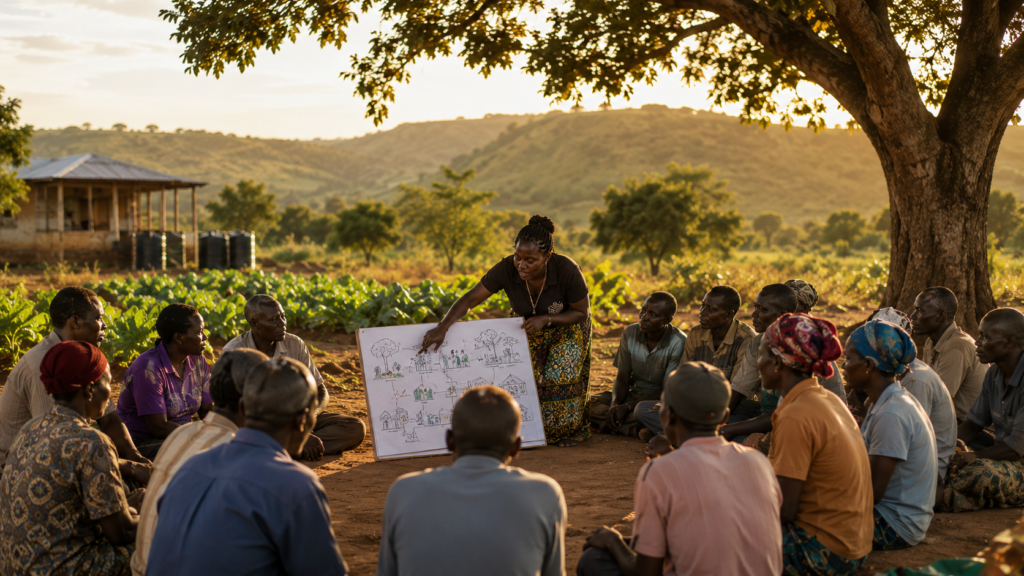
The Limitations of the “Band-Aid” Approach
To understand why policy matters, it helps to look at the developmental framework known as the Stages of Community Intervention.
Most well-meaning initiatives get stuck in Stage 1 because it offers the fastest emotional return. However, permanent transformation only happens when we advance down the line:
  [Stage 1: Relief] --------> Immediate crisis management (Food, emergency shelter)
         |
  [Stage 2: Development] ---> Capacity building (Skills training, local infrastructure)
         |
  [Stage 3: Policy Reform] -> Structural justice (Systemic funding, institutional equity)
When we operate exclusively in the realm of relief, we are constantly treating the symptoms of a disease rather than curing the illness itself.
Policy is the institutional glue that determines whether community development thrives or withers. It dictates how public funds are distributed, who gets access to quality healthcare, how local environments are protected, and whether grassroots organizations have a seat at the decision-making table.
Coalive’s Core Policy Pillars
We don’t view policy as abstract political debates. We view it as a practical tool to protect human dignity. In alignment with our mission to foster thriving, self-sustaining communities, Coalive focuses its advocacy on three distinct structural areas:
1. Equitable Resource Allocation and Grant Transparency
Grassroots and regional organizations are often the first to respond to community needs, yet they receive a fraction of national or international development funding due to bureaucratic hurdles.
- Our Policy Stance: We advocate for streamlined, transparent grant distribution frameworks that lower barriers for local, community-led initiatives.
- The Goal: Shifting funding structures from top-down mandates to bottom-up, community-driven allocations where funds directly reach the frontlines.
2. Sustainable Educational and Community Infrastructure
True empowerment begins in the classroom, but local education policies often leave marginalized communities behind, relying on volatile private charity to plug massive budgetary holes.
- Our Policy Stance: We support legislative frameworks that mandate baseline institutional funding for public schools, emphasizing digital equity, safe learning facilities, and fair teacher compensation.
- The Goal: Ensuring that access to a high-quality, modern education is treated as a fundamental right, not an accident of geography or socioeconomic status.
3. Protection of Community Assets and Local Autonomy
Too often, development policies are written for a community rather than with them, leading to displaced populations, mismanaged natural resources, or projects that don’t match local realities.
- Our Policy Stance: We advocate for policy models that require mandatory civic participation and local leadership consultation before any major public or private development projects are approved.
- The Goal: Protecting the land, resources, and cultural identity of the communities we serve by giving them legal agency over their own futures.
The Intersection: How Generosity Funds Advocacy
Many people wonder how a non-profit bridges the gap between daily operations and high-level policy. The truth is, they are entirely interdependent.
| Operational Action (The Ground) | Policy Translation (The System) |
| Funding a localized after-school tutoring program. | Using program data to lobby for regional literacy funding. |
| Repairing a broken water well in a rural village. | Advocating for stricter environmental protections on communal water tables. |
| Hosting leadership workshops for local women. | Campaigning for gender-equitable representation on local civic boards. |
Our daily work on the ground serves as our research laboratory. When you partner with Coalive, your contributions do double duty. They provide immediate, tangible relief to a family or school today, and they generate the hard data and proof-of-concept models we need to show lawmakers that our approach works on a larger scale.
Moving Forward: Becoming Policy-Minded Changemakers
A heart rooted in generosity must eventually become a mind focused on justice. If we truly love our neighbors, we cannot be content with simply pulling them out of the river; we must travel upstream to find out who or what is pushing them in.
As we look toward the future of community transformation, Coalive invites our donors, volunteers, and partners to expand their vision of what doing good looks like:
- Educate Yourself on Local Issues: Look into the structural challenges affecting your regional schools, housing systems, and community health centers.
- Support Systemic Initiatives: When you give, allocate a portion of your resources to projects that focus on capacity building, local leadership development, and systemic advocacy.
- Raise Your Voice: Use your platform to echo the policy demands of marginalized communities, ensuring that those who are most affected by bad policy have the loudest voice in shaping the cure.
Charity is the spark that shows we care. Policy is the engine that ensures that care outlives us. Together, let us build a world where structural justice matches our collective generosity.
Stand with Us for Structural Change
At Coalive, we are dedicated to doing the hard, structural work that leads to permanent freedom and growth. Join us as we advocate for policies that uplift, empower, and sustain.
- Fuel the Advocacy: Support our ongoing community-led systemic initiatives through our Donations